Thursday, December 14, 2017

Last Minute Gift Ideas!

If you're anything like me, right about now you're starting to panic because you realize there's only a few more days til Xmas.  Well, I put together some packages any skater is sure to appreciate and can ship them out within 24 hours of the order being placed!  These are also great for birthdays, anniversaries, or just to show someone you appreciate them.


First is the Derby Essentials Kit which includes hardware, bandages, hair ties, spare bearings, lip balm, and laces.  It comes in a cute metal container with the skater's name and number on the top. 


Another great option is the Skate Maintenance Kit, featuring a wheel bag, nylon axle nuts, hardware, bearing cleaning kit, bearing oil, skate tool, KT Tape, and a microfiber towel which you can have personalized.


Don't forget about your referees!  The Referee Starter Gift Pack includes 2 whistles and 2 lanyards, and there are options to upgrade the whistles or add the 2018 Bro-He-Can calendar to make this extra special.


I put 4 Referee Gift packages together that include different referee themed toe guards in addition to 2 whistles, sunglasses, and a lanyard.  Options to upgrade the whistles and add the calendar are available with each package.

Lastly, if you haven't seen the 2018 Bro-He-Can calendar yet, you should check it out.  It's definitely the most unique Roller Derby related calendar I've come across so far...


Hope that helps with the gift ideas! 

Until we skate again!
Shocker

Wednesday, December 6, 2017

Riedell Solaris Boots

Solaris Boots

I started hearing about the Riedell Solaris boots about a year ago and boy have they taken the derbyverse by storm!  When I finally got my hands on some, the first thing I noticed was how amazingly light they were, which is saying a lot since I had been skating with some very light carbon fiber boots.  Like many other skaters, I'm skeptical when new products are introduced and the $349 price tag was a little more than I wanted to spend at the time.  So instead, I watched as more and more skaters switched to these boots and listened to their feedback.


Solaris boots are made with high quality leather, heat moldable counters, and have a rounded toe box which helps them fit a wide range of foot shapes. They also have an antimicrobial perforated microfiber lining with moisture and odor resistant treatment, a huge plus for barefoot skaters such as myself.

Example of Custom Colors

For skaters who prefer a bit more flair, Riedell offers a pretty impressive array of custom color options for an extra $90.  You can even change the color of the ankle straps!


After selling about a dozen pairs of these boots and receiving mostly positive feedback, I ended up getting a pair for myself and so far I'm quite impressed.  For the past few years I have had to deal with hot spots, calluses, toe nails that don't want to grow right or end up falling out, and discolored parts of my feet, but the Solaris boots have given me hope that my feet will be pretty again!  They are unbelievably comfortable and there was no break in period.


The first time I skated with these boots, I had an issue with my heels slipping, almost wanting to pop out of the boots.  Solaris boots feature a narrow heel and V-Lock Strap around the ankle, so I didn't expect my heel to move at all.  I did a little research and found this video featuring Jackie Daniels which shows an interesting method for engaging the V-Lock Strap.  I started lacing my boots this way and no longer had any heel slippage.


Aside from heel slippage, I did end up switching out the insoles, but I've had to do this with all my previous Riedell boots as well.  Years ago at RollerCon, I complained to a Riedell employee about how crappy their insoles were and he said skaters end up throwing the insoles away so Riedell doesn't see a need to improve the quality.  I thought this was a strange response but I didn't pursue the issue further.  In any case, it didn't surprise me that I needed to change out the insoles, many other skaters may need to as well.

Quite a few skaters ended up buying (or wish they had bought) boots a half size smaller than what they normally wear.  This is likely due to the C/AA width which provides a wide area for the ball of the foot.  Feet tend to lengthen when squeezed so it makes sense they would be a tad smaller in a roomy boot.

Developing a blister/hot spot on the inner arch of the right foot happened to a handful of customers and one customer had it develop on her left foot.  In most cases, the blister healed and didn't return; however, some skaters ended up needing to wear eZeefoot Ankle Booties or something similar to prevent it from reoccurring.  All the skaters with this issue said it was a minor inconvenience and that they still loved the boots.

Other than that, I have only heard positive feedback, which is pretty amazing!  For about a year after the Solaris boots were introduced, they were selling so quickly that customers had to wait 6 weeks to get them.  Fortunately, Riedell has been able to catch up and many sizes are in stock and available now.
Solaris Sport Package


Solaris Boots $349


Solaris Sport Package $479

  • Plates: PowerDyne Reactor Fuse Nylon
  • Wheels: Radar Pop
  • Bearings: KwiK Zenith
  • Solaris Pro Package
  • Toe Stop: PowerDyne Jupiter


Solaris Pro Package $699
  • Plates: PowerDyne Reactor Pro Series
  • Wheels: Radar Halo
  • Bearings: KwiK Zenith
  • Toe Stop: PowerDyne Jupiter


These are just a couple skate package options but you can always mix and match to create your perfect setup.  I'd love to hear feedback on what other skaters think about the Solaris boots and what kinds of boot/plate combinations you are using.  Feel free to e-mail me at 2N1SkateShoppe@gmail.com with any comments or questions.

Until we skate again!
Shocker

Monday, November 20, 2017

PowerDyne Arius Platinum Plates


Young man on the Edvard Petrini's
pedaled roller skates known as Takypod in
Sweden, circa 1910
Did you know that roller skates have been around since 1743?  I had no clue until I started researching the history of skates for this article.  A few years ago a family friend gave me a pair of antique roller skates complete with  metal wheels and a skate key which I now proudly display in my shoppe.  It's crazy to imagine people skating in them and actually enjoying it, but they must have because roller skating never really went away.

In recent history, creative innovators have advanced the design, performance, and functionality of roller skates.  Many of these changes involved using new materials, tweaking angles, or shifting the placement of different components; however, the mechanics pretty much stayed the same...until the Arius plate was created.  

About 5 years ago, PowerDyne introduced Arius Red plates and boasted that they were "lighter, stronger, more stable, more powerful, more maneuverable, more durable, and more efficient than any other plate, hands down."  That's right, they used the word "more" 5 times in that one sentence.

To PowerDyne's credit, Arius Red plates really were quite impressive.  They were unbelievably light, could take a beating, and performed well, but the most surprising aspect of these plates was the absence of a kingpin!

PowerDyne Arius Red Plates
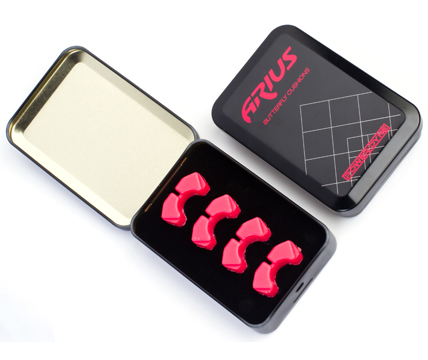
Now, as we know for all other plates, kingpins hold cushions and trucks in place and are adjusted by tightening/loosening the kingpin nut for optimal performance.  Well, with the Arius plates, the axles press the trucks against specially designed Butterfly Cushions...eliminating the need for a kingpin.  Once you find the cushion hardness/combination that's right for you, there's no need to make further adjustments.


Arius Red Butterfly Cushions
I have talked to quite a few skaters who used/still use Arius Red plates.  Many said it took a bit of an adjustment period, from 1 practice to two whole weeks of skating, before they felt comfortable.  Finding the right cushion hardness by trying different combinations seems to be key; however, most said that after they got everything set up they loved how the plates performed.  As a dealer, I got to know the plates fairly intimately when mounting them to boots or working on them for customers and I found them to have a couple design issues.

The first was that the original toe stop screw was difficult to tighten enough to firmly hold a toe stop.  PowerDyne ended up coming out with a new toe stop screw that helped with this issue, but you still had to tighten it down hard to get the toe stop to stay put.  The second frustrating design was that the cushions were held in place by tiny screws, 1 on each side of the cushion which meant 4 tiny screws per plate, 8 total for the pair.  These screws were a pain to remove/install and were easily lost.


Apparently PowerDyne listened to their customers because, in 2016, they introduced the Arius Platinum plate.  This version featured the same innovations as the original Arius model, but also included a couple upgrades making them not only perform better, but easier to work with.  You can see in the pic below that the toe stop screw is now located toward the front of the plate instead of behind the toe stop, the new design makes securing the stop much easier.

Arius Platinum Plate


New Split Butterfly Cushions


PowerDyne also redesigned the trucks and cushions, eliminating those 8 tiny screws altogether (yay!).  Unfortunately, the new Split Butterfly Cushions are not compatible with the old plates and vice versa, but it's a small price to pay for making the cushions so much easier to replace/swap out.

A couple months ago, I ordered myself some Arius Platinum plates mounted on the new Solaris boots (my next article will cover Solaris boots).  The first time I tried the new setup, I encountered ran an issue that I wasn't expecting... I couldn't control my feet!  I felt like my skates were moving in and out on their own and I didn't feel comfortable lifting my wheels off the ground to do a simple crossover.  I must say, I freaked out quite a bit on the inside but tried to remain calm.  I changed out the cushions out for harder ones, which seemed to help somewhat but I could tell something else was wrong.  After trying the new skates out twice without much improvement, I grabbed my old skates to compare my plates...the axles on the Arius plates were spaced an inch further apart than my old Venus plates! According to the Arius plate size chart, I should need a size 8 plate for my size 8.5 boots and that is the size Riedell mounted on my boots before sending them to me.  I ended up removing the size 8 plates and mounted size 6 instead, which only had about a quarter inch larger axle distance.  The next time I tried them out I was able to skate like I had with my old setup, the difference was like night and day.  I'd definitely recommend comparing the wheel distance of the Arius plates with whatever you are currently skating on to see if you may need a size other than what is suggested.

Now that I've been able to skate with the correct size Arius Platinum plates for a few weeks, I can say I really do like them.  They feel different than plates with kingpins...I feel more stable yet jukey/agile at the same time.  I haven't had any issues with my toe stops, the screws tighten as expected and don't loosen on their own.  Playing around with the different hardnesses of cushions has been interesting, the plates come with 4 sets of cushions so you shouldn't need to purchase separate cushions right away.  PowerDyne offers 9 different cushion hardnesses for the new plates which means it's likely there is a combination for any skater out there.

Custom Solaris Boots with Arius Platinum Plates
(Pic courtesy of Jules Hannah)
You're probably asking yourself, "if these plates are so great, why doesn't everyone have them?"  Well, the $349 price tag is definitely a little steep.  One option that isn't going to be around for very long is to go with the Arius Red plates currently on clearance for $199.  Very limited availability on these!  These are no longer available. 

If you end up purchasing the Arius Platinum plates, they could very well be the last set of plates you ever need to buy, which isn't a bad investment.

As always, feel free to send comments/questions/feedback to me at 2N1SkateShoppe@gmail.com.

Until We Skate Again,
Shocker


Wednesday, October 4, 2017

Smith Derby Knee Pads

There are quite a few knee pads on the market ranging from about $35 to over $100.  Smith Scabs Elite knee pads have been an extremely popular option for years and I personally used them for about 5 seasons, so when I heard that Smith came out with a Roller Derby specific knee pad I was excited!

I noticed a few things right off the bat:

  • At $40 for a set, they are at the lower end of the knee pad price range.  The other knee pads in this price range I've tried didn't hold up well to the rigors of Roller Derby, so I was a bit skeptical.
  • They wrap around your knee with a butterfly type enclosure (like the Smith Scabs Elite or 187 Pro Derby knee pads) which is a huge plus!
  • They come in a wide range of sizes, from Small to XXL for adults and 2 junior sizes.

 I've been using these knee pads for a few months now.  So far I really like them and would recommend them for skaters who have a season or 2 of experience.  For newer skaters, I'd recommend going with the Scabs Elite or 187 Pro Derby knee pads for extra protection.

Like many knee pads, these start off fairly stiff but after a couple practices they relaxed and felt more comfortable.  The padding isn't as nice as higher-end knee pads, but it took me falling on my knees pretty hard before I noticed a difference.

The only issue I have found so far with these knee pads is that the sizing runs fairly small.  Be prepared to go up at least 1 size than with other knee pads.

Overall, I definitely think Smith Derby Knee Pads are worth trying if you are in the market for new knee pads.

Until we skate again! Shocker

Wednesday, June 7, 2017

Halo Wheels, Straight From Heaven!


Radar has done it again, revolutionizing Roller Derby wheels with their newest offering: Halo Wheels!


Halo "H" Shaped Hub
Halo wheels were designed with an oversized hub which is shaped to have more urethane in the center and less on the edges.  Radar claims "this makes it easier to perform stops and offers excellent response. The middle of the hub has room for more urethane, which offers grip, increases control and improves ride."  And you know what?  It's absolutely true!


I tested the Halo 93a (pink hub) wheels and was super skeptical.  I'm a heavier skater so for the last couple years I preferred to skate on aluminum hubbed, 62mm wheels.  Every time I've tried to go to nylon hubbed, 59mm wheels I felt the wheels flex and felt sluggish.  However, the Halo wheels surprised me.  I absolutely loved them!


I felt no flex with the Halo wheels, felt no loss of speed, and they were very responsive.  On top of all that, they are super lightweight at about 10.6 oz per 4 pack.

Image may contain: shoes


Halo wheels only come in 59mm, which is a bit of a bummer for those of us who prefer taller wheels but the range of 6 hardnesses makes up for it.  The grippiest Halos are 86a and the hardest are 97a.


Image may contain: shoes
New Solaris Pro Package


I've had many skaters purchase these wheels or rent them from my wheel library and have gotten almost all positive feedback and most wheels were purchased after being checked out.  Some skaters have had to try a couple different hardnesses before finding the right balance between speed and grip and one skater had an issue with chunking (in this case Radar replaced the wheels, no questions asked) but other than that skaters seem to love these wheels.  If you are looking to try something new, I'd definitely recommend getting some Halos.


Until we skate again!
 Shocker

Friday, May 12, 2017

S1 Lifer Visor Helmets

Hello Derbyverse!  I know it's been a long time since I've posted, I'm sure you know how life can get in the way sometimes...in any case, there are quite a few new products on the market that I've been trying out or getting feedback on so I can pass this info onto you!

Glitter Black Visor Helmet

The first product I'd like to talk about is the S-One Lifer Visor helmet.  The original Visor helmet was released a little over a year ago and sold out quickly; however, as with many first time products on the market, it had a few tweaks to work out.  A few months ago, the Visor 2.0 was released with improvements such as a better way to keep helmet panties from slipping off and a removeable visor for those times you don't want to use it, it gets scratched up, or you want to swap out with the Iridium visor which acts like sunglasses for your helmet.  The Iridium visors are not approved for WFTDA play, but would be awesome for trail skating on sunny days.
Iridium Visor
Clear Visor


Caveat: I haven't personally worn the Lifer Visor helmet.  I've worn Lifer helmets for years and haven't had any issues with them. From personal observations as well as testimonials, some skaters tend to get hit in the face more often than others or wear glasses which can cause quite a bit of damage when hit by the stray shoulder.  Other skaters wear contacts which dry out pretty quickly when skating on the track and the Visor helps to prevent the wind from drying them out.
Silvie Postlewaight,
Currently Skating With Glasgow Roller Derby 


I received reviews from quite a few skaters who have been using the Lifer Visor helmet and here are the pros and cons they mentioned:

Pros:

  • Visor protected the skater's face from a hit that ended up gouging the visor. (Potential eye damage avoided)
  • Protects the eyes and noses of shorter skaters.
  • Helps keep bugs from flying in your eyes when skating outside.
  • Visor is easily removeable/replaceable so you can choose to wear it for some activities and take it off for others where you are less likely to get hit in the face.
  • "I feel like I look really darn cool when wearing this helmet." -Lauren Malis

Gold Glitter Lifer Visor

Cons:

  • Visor got scratched during the first part of an international game to the point vision was impaired.  Unfortunately, this skater lives in a country where getting a replacement visor is cost prohibitive otherwise getting a replacement visor would quickly solve this issue.
  • Some skaters reported the Visor helmets were hotter than the normal Lifer helmets; yet still not as hot as many of the hockey type helmets they previously tried.
  • One skater stated that the extra weight bothered her, none of the other skaters mentioned this.
  • One skater mentioned when being hit from the side, the noise was startlingly loud.
  • Takes some practice getting helmet panties off and on.

Glossy Red Visor Helmet
For the most part, I got very positive feedback on the helmets.  Most of the skaters just stated that they loved their helmets with no extra information to back it up.  In my experience, when skaters have issues with their gear, they have no qualms stating so...when things are going great and working well, I usually don't hear much feedback.

Overall, if you have issues getting hit in the upper face due to being a shorter skater or just from skating styles of those around you, I'd definitely give the S-One Lifer Visor a shot.  One thing I'd like to point out, the visors come with a thin removable film on them so if things look blurry at first, make sure you've taken this film off.

Purple Visor Helmet

Hopefully that gives you a little insight on these helmets.  If you have any further feedback, feel free to leave a comment or message me at 2N1SkateShoppe@gmail.com


The next articles that I currently have in the works are for Halo, Savant, and Anabolix wheels as well as the new 187 Slim elbow pads and Smith Derby knee pads.  If you have any feedback on any of these items, I'd love to hear from you!

I'm also working on some general Roller Derby articles for Marni Boer's project All Things Derby, so check out all the goodies she's got going on over there.

 Until we skate again! Shocker

Thursday, December 10, 2015

New Gumball and Superball Stoppers Toe Stops From Grn Mnstr

Revamped Gumball and newly introduced Superball toe stops have arrived, but are they worth trying out?

The original Gumball toe stops were the first stops developed specifically for Roller Derby and they were amazing compared to the other options available; but they had two annoying flaws.

  • They needed to be broken in which usually involved a lot of turn around toe stops on a rough surface; and
  • They wore down rather quickly.


Let's take a look at the new Gumballs.  

The packaging is almost the same as the old style, retail at $20/pair, and they are available in two stem lengths; Standard 30mm and Short 17mm.  However, this is where the similarities end.  Grn Mnstr listened to skaters when developing the revamped Gumball stops, which now feature:

  • More material;
  • Better durability;
  • A pre-molded flat spot for more usable surface area; and 
  • Fancy new multi-colored stems: Blue, Green, Magenta, Red.


When I first received these new toe stops, I was skeptical.  The material felt the same to me as the old ones and I thought I'd have to do a bunch of turn around toe stops to break them in; however, that wasn't the case.  They performed well right out of the package.  

One of my teammates also tried them and had this to say;

"The new ones break in a lot easier! I didn't have to go outside to wear a flat spot, which was nice considering the snow ruined that plan! The transition wasn't weird at all, I played in a game right after putting them on with no issues. I also like the pretty colors!"  -Purrenrage, Rage City Rollergirls


Both the new Gumball and Superball stops come with 4 different colored stems, which are randomly placed in packages so skaters don't know which colors are included until the package is opened.  The stems are unmatched, which makes my OCD twitch a little, but the 12 year old girl in me secretly likes that every package contains two different colored stems.


The Superball toe stops come packaged in an interesting cube box which features illustrations of a caped, roller skate wearing super hero stopping a train and bounding over tall buildings.

There is also a window which shows off the most unique aspect of these stops...they are the first dual durometer (dual hardness) toe stops.  The majority of the Superball Toe Stops is comprised of classic natural Gumball rubber for ultimate grip and traction; however, for better durability, eight slightly harder pods that run through the stop were added.


Dime for Scale (sorry, out of bananas)


The packaging is much larger than any other toe stops I've come across, but after opening the box the reason becomes clear.  Superball toe stops are HUGE!  At 60mm wide (2.36"), these are the largest toe stops I've heard of.  They are 3mm larger than the Big Bloc toe stops and just over half an inch smaller than a regulation size hockey puck.  (see image to the left for scale).


The stops are shaped in a way to prevent wheel bite (when wheels grind against toe stops) and I found this to be essential due to their size.  They also feature hollow stems which makes them lighter than they look (see image to the right).

Grn Mnstr states that this combination of dual compounds and oversized stopping surface insures the best in stopping power and stability, and I must agree.  I am often skating backwards, bracing my teammates as a jammer attempts to break through our wall.  With other toe stops, I would find myself sliding a bit but with these I was able to keep the wall stationary.  The grip and stability really are incredible.  Here is what another teammate of mine thought about them:

"Pros- Super stable & solid and good to go right out of the box.
Cons- Aesthetics. They're comically, almost obscenely large and goofy looking.
Looks aside, I really like them and am looking forward to seeing how they wear."
 -Cybil Shephurt, Rage City Rollergirls
Superball toe stops retail for $32/pair, but considering they all the features they offer and their performance so far, I think they are worth it.

If you are interested in purchasing either of these stops, here are links to the 2N1 Skate Shoppe pages for each of them:

Gumballs
Superballs

Until we skate again! Shocker

Wednesday, December 17, 2014

Faster Wheels

Congratulations to the Roller Derby haiku winner, Alysha Shipley, for submitting the following poem:

First lace up your skates,
hit the track and free your mind.
Roller Derby Chick!

To claim your prize, please send me an email at 2N1SkateShoppe@gmail.com with your shipping address and you'll get a box of goodies in the mail!

Today, I'd like to discuss Faster wheels.

Faster Wheels in 3 (Dual) Hardnesses

Revolutionary
Faster sent me a set a while ago to try out and I must say, they are quite interesting.  The wheel is designed in 2 parts, the tire (urethane part of the wheel) and the hub (inner part in which the bearings sit).  When the tire gets worn down or has been regrooved a few times, it can be removed from the metal hub and replaced with new tires.

Faster Tire
Faster Hub


Price
Many experience a bit of sticker shock when they first see Faster wheels' initial price (around $150 for a full set of 8 wheels); however, replacement tires range in price from $75 to $85.  This may still seem like quite a bit of money for just the outer portion of the wheel...but most of Faster's wheels are dual durometer.

Dual Durometer
There are a couple different styles of dual durometer (dual hardness) wheels on the market.  The Juice Wheels Martini series is comprised of a hard urethane core with a stickier surrounding layer.  Faster created wheels where the outer, white portion of the tire is hard and the inner, colored strip grippy (see pic of complete wheels above).  This allows skaters to evolve from pusher setups (which I don't recommend for flat-track derby) to having a whole set of matching wheels.

Importance of Consistency
Some skaters use a "pusher" setup, which usually means the left wheels (when viewing skates from above) are stickier/softer than the right wheels.  I don't advocate this type of setup for most Roller Derby skaters.  All players, regardless of position, need to be able to push off their wheels in any direction.  Jammers need to juke and blockers need to hit to the outside as well as inside of the track.  This becomes trickier when skating on wheels set up to grip in one direction and not the other.  Pusher wheels are great when speed skating, but when it comes to Roller Derby, the action occurs in every direction.  The dual durometer Faster wheels offer ensures consistent grip in any direction.

Pros and Cons
Pros:
  • Consistent grip while not sacrificing speed.
  • Removable and replaceable urethane tire.
  • Attractive wheel composition (important to some skaters).
  • Variety of durometers, widths, and heights available to choose from.
  • Created and sold by actual Roller Derby skaters!

Cons:
  • On the heavy side of the Roller Derby wheel spectrum.
  • Initial price may be an issue for some skaters.

There are a lot of skaters who love Faster wheels and I would recommend anyone in the market for a new set to consider them.  If you don't want to plunk down $160 before trying them out, check a set out from the 2N1 Wheel Library for a $50 deposit and you can skate on them for 2 weeks before deciding whether to return or purchase them. 

Until we skate again!
Shocker

Thursday, November 6, 2014

Rollin News Cross Post - Founder's Syndrome

Wow, it has been waaay too long since I posted an article!  I wholeheartedly apologize for this and blame fiveonfive and Rollin News for taking up my time writing for them not to mention 2N1 Skate Shoppe becoming more and more popular (not complaining, just explaining).

Anyway, I thought it would be nice to follow the lead of some of my favorite shows and do a crossover post.  I recently wrote a couple somewhat controversial articles for Rollin News in which I discuss Founder's Syndrome (also known as Founderitis) in Roller Derby leagues and have posted both below for your reading pleasure.

Feel free to comment with your own experiences with Founder's Syndrome and come up with a haiku if interested in possibly getting a goodie bag.  Well, without further ado:

Board of Dictators


Imagine
You are one of the founding members of your league, have served on the Board of Directors (BOD) since the beginning, and any time the league faces tough choices, you never hesitate to make decisions. The league is your baby. You were more than eager to teach how to tie the laces on its first pair of skates, you jumped at the chance to help think up and yell its first jeer, and you lovingly nurtured while it stumbled through the league's first home bout. You honestly feel if you weren't making important league decisions, the league either wouldn't survive, or would end up evolving in detrimental ways...so, why in the world would you relinquish your power? Instead, you do whatever it takes to ensure the league continues to head in the direction you know is best. Those who disagree with your decisions either don't understand your vision or don't have the league's best interest at heart. You would rather see the league “split” or dissolve before allowing anything you don't agree with to occur.

Have you met, or heard of, someone who could relate to this scenario? Have you been a member of a league where an entitled member, or members, called the shots while ignoring differing opinions, even when the majority of the league was in favor of those opinions? Did you leave a league to join or start a new league because something like this happened? Or...perhaps you find yourself agreeing with and relating to the person described above, nodding along to each sentence as if I'm describing you.

Whether the opening paragraph describes you or someone you know, I'm sure the league involved has had to deal with internal strife because of it and if it hasn't yet, someday soon it will find itself in crisis. Hopefully this article will give you some insight into this type of issue and a few ideas on how to deal with it, no matter what side of the track you're on.

Founder's Syndrome
Since I started playing Roller Derby almost 6 years ago (wow, where has the time gone?!), I have heard of, and experienced, leagues suffering from “Founder's Syndrome.” Founder's Syndrome (also known as Founderitis) occurs when one or more creators maintain disproportionate power and influence after establishment, leading to organizational and personal issues. I think this quote from the Founder's Syndrome Wikipedia article is an excellent description, “The passion and charisma of the founder or founders, which was such an important reason for the successful establishment of the organization, becomes a limiting and destructive force, rather than the creative and productive one it was in the early stages.”

Founder's Syndrome (FS from now on) isn't unique to Roller Derby leagues and can occur at any non-profit or for profit business; however, many of us never encountered it until we became involved with this sport so dealing with it has been a struggle. Those struggling from FS may not even know of its existence.

FS can be very destructive to an organization. When members feel their opinions are not being considered and their needs not being addressed, league morale plummets. When league members are unhappy, word spreads, which can cause a decline in membership. As the divide between the privileged few and league majority grows, so does bad blood and visceral hatred for those in positions of power. Volatile tension increases until the unhappy masses either implement a hostile takeover or quit to form their own league or join an existing one nearby.

Unfortunately, this isn't just a cautionary tale...and it gets worse. Those suffering from FS not only cause league animosity, some of their attempts to maintain control could be illegal. Each individual state has laws pertaining to businesses formed as corporations (which is the business model most leagues operate under nowadays), whether non-profit or for profit, in regards to items such as voting, meetings, minutes, etc. For example, in Alaska, any corporation's Board of Directors (BOD) has specific notification requirements prior to holding meetings or when proposing to change corporation bylaws. They must also keep adequate minutes of all BOD meetings and have these minutes available when requested by shareholders/members or else they could face at least $5,000 in fines. From what I've gathered, actual jail time is probably not going to occur unless something like embezzlement is going on, but just one fine of $5,000 would seriously impact any Roller Derby league's bottom line.

Now that we have discussed some worst case scenarios, let's talk about how to avoid the pitfalls of FS in the first place...

Preventative Measures
Whether you are the founder of a league or later find yourself in a position of authority, you have the power to keep FS symptoms at bay. First and foremost, have an exit strategy. If you have the mindset that you are going to occupy that position for a specific amount of time and truly want the league to thrive when the next person fills that role, the league has a much better chance of surviving. Instead of keeping information close to the vest, create/update league documents with instructions on how you perform specific tasks pertaining to your position. When it comes time to hand over the reins, don't think of it as letting go of whatever prestige or power that came with that title. Instead, think of it as a graduation. Just like completing high school or college, graduating from a position of authority is an opportunity to transition into a new phase of your life.

For the league, changeover can help keep things fresh when those elected have new ideas and different skill sets than the previous incumbents, which helps to prevent burnout. It can be difficult to hand your baby over to be cared for by a new individual. You need to have faith in your fellow league mates and believe they too are looking out for the league's best interests. Yes, sometimes new ideas end up flopping or the person you thought would do really well ends up not being a good fit, but that's ok. Mistakes happen, that's how you grow as a league and find new ways to tackle issues. Once you overcome an obstacle as a league and put safeguards in place so it doesn't happen again, your league will be stronger for it.

FS For Life
Roller Derby culture is one of acceptance, compromise, and inclusiveness; however, every once in a while you'll find someone so taken over by FS symptoms that they would rather destroy their league, their “baby,” than see anyone else take over. If you know of someone like this, please encourage them to be completely transparent and create a league with a sole-proprietor business structure. This way, there are no pretenses or false promises and those who join are aware of what they are getting into and how the league will be governed.

If you have faced challenges involving those suffering from Founder's Syndrome, please feel free to share your story in the comments section, especially if your league was able to overcome and continue to survive afterward.  I look forward to hearing form you.

Board of Diplomats


My previous article, Board of Dictators, discussed how Founder's Syndrome (FS) has negatively effected Roller Derby leagues, sometimes causing leagues to split or even completely dissolve.  I received some great feedback through emails, personal discussions, and comments to that article and would like to clarify some points.

Leagues are Unique
Some of the discussions I had concerning FS and the previous article made me realize I didn't emphasize this enough: not all league founders will develop FS.  A founder, or anyone for that matter, can be in a leadership role for a lengthy period of time of a thriving league.  When I say thriving, I don't just mean monetarily. 

Thriving leagues have clear policies in place which are followed and understood by the members and also updated as needed to keep up with changes affecting the league.  Thriving leagues address issues head on and work with members to ensure their needs are not being overlooked.  Thriving leagues conduct business openly by properly informing and inviting members to attend important meetings and providing access to league documents (BOD minutes, financial statements, voting records, etc.).

Secrecy leads to distrust, which in turn causes frustration, confusion, and internal strife; however, it doesn't have to be this way.

Delicate Balance
As mentioned in the previous article, leadership turnover has its advantages.  Newly appointed leaders often bring different ideas to the table and may be able to view old issues from a previously overlooked viewpoint.  Fresh blood also helps to prevent burn out, which occurs when someone is in a position so long that they become bored while feeling overworked and uninspired. 

While many of us have felt burned out at some point in our lives, something special happens when we find a job we are good at that challenges and excites us.  If your league has a president who does an excellent job leading your thriving league and they happen to be one of the league founders, it's not necessarily a bad thing for them to continue to serve the league in that position.  The problem occurs when symptoms of FS cause issues to the detriment of the league's ability to thrive.

Big Picture
So, how can you tell if you and your league are suffering from FS or if you have found your place in the system?  Try to take a step back and look at the situation from an outsider's perspective.  Do you feel like you have to hide or make decisions behind the membership's back or are you comfortable bringing possible changes to a vote, ready to proceed no matter the outcome?  Do you conduct business behind closed doors or is information given and made readily available for the members?  Do you feel wiped out and physically/mentally destroyed when having to deal with league issues, or are you invigorated? After honestly answering these questions, you should be able to come to a conclusion as to which side of the fence you stand (or, in our case, skate).

I hope this was able to clarify a few points and show that just because someone is in a position for a lengthy period of time, and happens to be one of the league's founders, they (and the league) aren't necessarily suffering from FS.

Thank you to all of those who contacted me to tell me their stories and experiences with this subject matter.  To show my appreciation, I would like to give away some goodies!  In order to be considered to receive one of these goodie packages, all you have to do is come up with a Roller Derby themed haiku and enter it into the comments of this article.  I'll choose a few winners and announce them with my next Rollin News article.

Until We Skate Again!
Shocker

Saturday, July 19, 2014

Quick Tip: How to Remove Sure Grip Avenger Pivot Cups

The Sure Grip DA-45 Pivot Cups are made of Delrin nylon, and are among the longest-lasting pivot cups around, but even they should be replaced periodically. These cups are standard on the Sure Grip Avenger, Invader, and XK-4 plates using the DA-45 trucks.

If you've ever tried to remove the cups, you know how tight of a fit they are, and it is virtually impossible to remove the cup without marring the plate and likely breaking the tips off a few tools in the process!

This little hole is our saving grace!


Some plates have a small hole on the back side of the plate to allow you to push the cup out, but not these - making removing the plate a fruitless effort. So, how to get these cups out without damaging the plate, breaking our tool, and stabbing ourselves in the hand?


Luckily, Sure Grip was nice enough to put a small hole in the bottom of the pivot cup. This hole allows air to escape from between the cup and the plate when installing the pivot cup; but more importantly for us, it gives us a handy way to remove the cup.
Nothing like a good screw.


First, find an appropriately sized screw. I use a standard coarse-thread drywall screw, but pretty much any similar-sized wood or sheet metal screw should work (obviously, you want to make sure it's not a self-drilling drywall screw meant for metal studs, lest you end up with a hole in your plate and sole of your skate!).


Starting to move!


If you want to make the process a little easier, you can put a drop of bearing oil in the bottom of the cup, but it is not necessary. To begin, drive the screw into the hole using a screwdriver. The king pin will be in the way a bit, but it's easy enough to work around. (You can remove the king pin of the Invader or XK-4 if you'd like, but it is not necessary, and the kingpin of the Avenger is not removable in any case.)

Almost there!


Once you drive the screw through the pivot cup and it starts pressing against the metal plate, the pivot cup will start to be forced up and out of the cup. Continue to drive the screw until the pivot cup is pushed up to the point where it starts spinning (usually this happens once it gets about 90% of the way out of the cup). At this point grab onto the cup with some pliers and pull it out the rest of the way. That's all there is to it!


Ta-da!

Until we skate again!
Shocker

Friday, June 27, 2014

Skater, Feel Thy Feet!

Picture it:  You are about to skate for 5 minutes to determine whether you will remain a rookie for another season or skate your way to rollergirl.  You made sure to hydrate, eat well, and have adequate time to warm up, yet after only a few laps, a familiar sensation begins to creep from the tips of your toes through your feet, and soon, it will be making its way up your lower legs.  You know something bad is about to hit you...hard. 

Today we are going to discuss an issue that plagued me, as well as many of my teammates, during the first few years of our Derby careers.  Can you relate to the scenario described above?  Even if you have never actually experienced this exquisite pain, I'm sure you have skated with someone suffering from it.  The unique combination of foot/lower leg pain and numbness is often only relieved after taking your skates off, which means you'll have to spend the rest of practice watching from the sidelines.  If you haven't yet found other ways to prevent/relieve this problem, such as stretching your calves and shins before and after practice and icing inflamed areas, you may only need to make a few simple adjustments to your laces to get the pain to subside. 

But before we get into some preventative measure lacing techniques, let's take care of an administrative issue.  In the previous G Spot post, I announced the 6 lucky "Shocker's Box O' Goodie" winners; however, only 2 of them have e-mailed me their mailing information.  I have yet to hear from:

  • Ashley Dawn
  • Tracy
  • Amanda Brown
  • Amanda Duncil

If you know someone on this list, please shock them with a cattle prod and let them know they need to email me their information.

For June, I'm going to give away one (or a few if I'm feeling generous) of my popular DerbyPunk Wine/Liquor Bottle Stoppers to a follower of my new Etsy store, The ShockerKnot.  When you stop by my store and click on the "Favorite" button, why not check out the Roller Derby inspired items I've created?  You may find the perfect gift for your favorite Rollergirl/guy, or even yourself!  New items are added all the time, so visit often and get the jump on the latest creations.

Now, back to painful problems.

Lace Your Way to Pain Free Practices

In the last G Spot article, "What a Tangled Web We Weave...er Lace," we discussed various skate lace attributes such as length, material composition, and color availability.  Now let's talk about how you can use different lacing techniques to reduce/relieve discomfort when skating or prevent pain from occurring in the first place.

Double Up
The "Double Up" method is a simple lacing technique involving 2 pairs of shoe laces (not skate laces) each about 45" in length.  As depicted in the following photographs, the bottom half of the boot is laced with one pair of laces while the other pair is used for the top half.  Each lace is tied off with a bow or appropriate knot and is not connected to the boot's other lace.

First one laced and tied off.
Finished Product
Second lace added.

This technique is useful for skaters who need to use different tensions when lacing their boots, such as needing to lace the bottom half as tight as possible while leaving the top half loosey goosey (oh yeah, I went there).  If your boot presses against the nerves in the foot or ankle, it can easily cause serious discomfort; however, if the skater is able to pinpoint the area where the skate irritates her nerves, this technique can help to keep the laces loose in that specific spot while still being able to tighten the boot enough that her skate doesn't fly off the track without her.  This method also allows skaters to show off twice as many crazy/cute laces, such as these ------------->


Uncrossed Laces

If you tried the double lace method and are still having pain when skating, you may need to avoid lacing over certain parts of your feet entirely by using a technique I like to call “Uncrossed Laces.”

To do this, you will end up with your skates laced normally (horizontally) above and below the area causing you discomfort, but will lace vertically in order to avoid putting pressure on the sensitive area.


How to lace boots using the Uncrossed Laces technique:

End Uncrossed Lacing

Suspected Problem Area
Begin Uncrossed Lacing


Return to Normal Lacing
Uncrossed Lacing Completed

Lacing Through Tongue Loop

As you can see, once you reach the sensitive area, instead of crossing the lace to the opposite side, you thread it through the next rivet on the same side. You lace vertically through one or two rivets, but I wouldn't recommend more than two because the tongue could end up popping out or sliding to the side. After you are done lacing vertically, resume normal lacing through the rest of the rivets and the tongue slot.


If the tongue in your boot bunches or slides to one side, make sure you have laced through the slot in the tongue if you have one, not all tongues do (I could make a dirty joke here, but that would be out of character).


Something else that may help is warming up without tightening your laces.  As in, after you put your skates on your feet, you don't touch your laces at all before you start to skate.  You may want to tuck in your laces so you don't end up rolling over them and if you have an ankle strap, it's helpful to velcro it back on itself to get it out of the way.  

I started warming up this way about a year ago and noticed a huge difference in how my feet feel during/after practice. If your skates fit properly, you should be able to skate fairly normally after slipping your feet into your boots. After warming up for 5 to 10 minutes, lace up as usual; not too loose or super tight. You should notice that your skates suddenly feel like extensions of your body, as if long lost orphans have finally returned to their place of birth. It's an awesome feeling which is difficult to describe.  When I lace my boots after warming up, I suddenly feel like I can jump, turn, and juke like Suzie Hotrod.  My feet become more responsive and my shins/calves don't cramp like they used to. 

If you end up trying this out, give yourself time to get used to the feeling and mechanics of skating like this. It may take a few practices, but once you get to the point you feel comfortable skating "unlaced," you'll be able to get the most out of this technique.

If you find that your heels tend to slip out of your skates, even after you tighten your laces, you're in luck!  The next G Spot post will go over some tips for keeping your heels nice and snug in your boots.

Until we skate again!
Shocker